Mass Transit & Infrastructure LED Lighting

When the MTA needed to modernize lighting across 15 subway stations, they turned to Clear-Vu. Purpose-built solutions for the harshest underground environments.

Lighting Engineered for Underground Infrastructure

Subway tunnels, rail corridors, and underground stations punish lighting like nowhere else — water infiltration, brake dust, constant vibration, and 24/7 operation. Standard commercial fixtures fail in months. Our transit systems are engineered for it from the ground up.

Modern tunnel interior with continuous LED lighting along both sides

Water & dust ingress

MTLx tunnel fixtures carry IP66/IP67 ratings — fully dust-tight, sustained water-jet and submersion rated.

Constant rail vibration

Vibration-resistant quick-connect mounting absorbs and dissipates energy across 50,000+ hours of pass-bys.

Salt-laden corrosion

Marine-grade aluminum housings selected for coastal transit networks like NYC's subway.

Emergency wayfinding

3-step DALI dimming maintains evacuation-grade illumination on backup power.

Network-scale monitoring

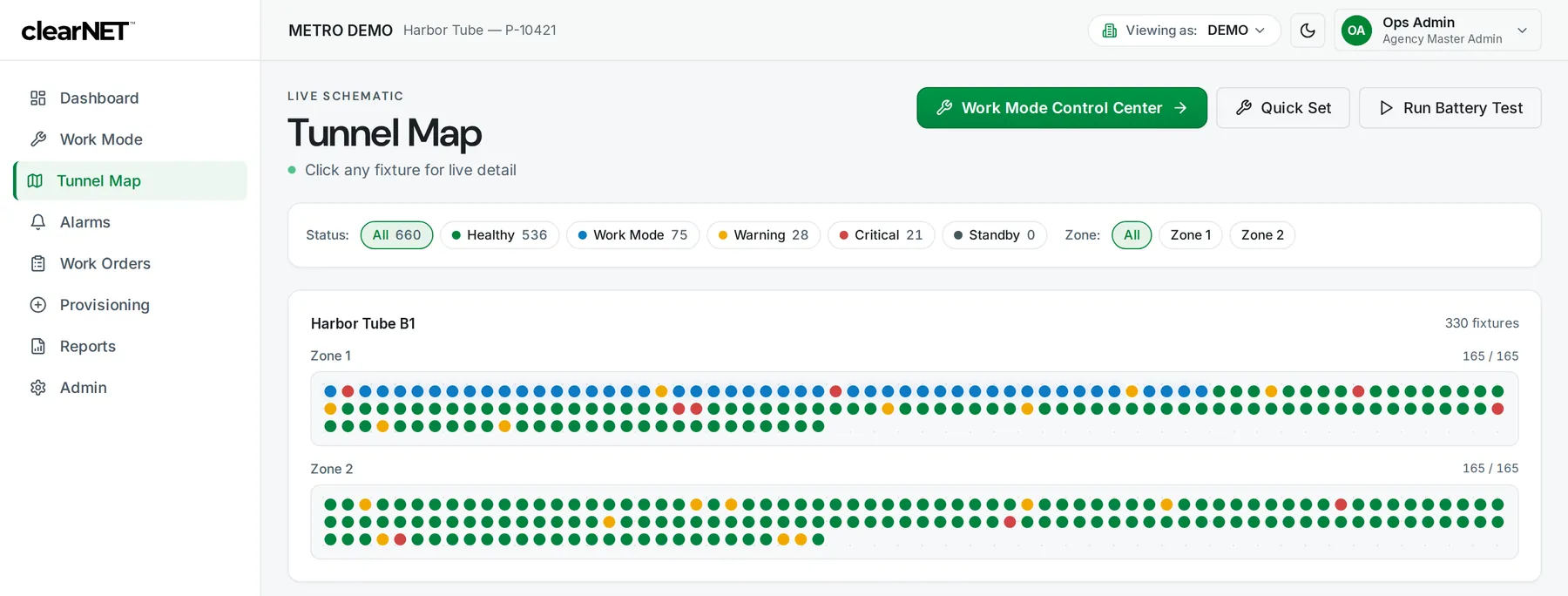
clearNET self-healing wireless mesh delivers real-time fault detection across entire systems.

Specification confidence

Our 31-page Driverless LED white paper has informed transit-agency specs nationwide.

Purpose-Built for Mass Transit

Three integrated systems that work together to deliver complete transit lighting solutions — from individual tunnel fixtures to network-wide intelligent monitoring.

MTLx Logo

MTLx Tunnel Fixture

Purpose-built for the harshest tunnel environments

The MTLx represents the culmination of decades of transit lighting engineering. Every component — from the marine-grade aluminum housing to the vibration-resistant quick-connect mounting system — is designed for one purpose: uninterrupted performance in the most demanding underground environments on earth.

IP66/IP67 rated enclosure
Vibration-resistant mounting
Tool-less lens access
50,000+ hour rated life
Emergency backup ready
BABA/BAA compliant

Applications

Subway Tunnels Rail Corridors Underground Passages Utility Tunnels

Key Specifications

IP Rating IP66/IP67
Construction Heavy-gauge marine-grade aluminum
Mounting Vibration-resistant quick-connect
Rated Life 50,000+ hours
Maintenance Tool-less lens access
Emergency 3-step DALI dimming
Certification UL, DLC, BABA/BAA

Key Specifications

Network Self-healing mesh topology
Control Zone-based dimming and scheduling
Monitoring Real-time energy and fault monitoring
Protocol Standard wireless mesh
Integration SCADA / BMS compatible
Savings Up to 70% energy reduction
NETWORK ACTIVE
247
Active Nodes
99.8%
Uptime
-68%
Energy Usage
clearNET Logo

clearNET Wireless Mesh

Intelligent wireless monitoring for connected transit systems

clearNET transforms transit lighting from a passive infrastructure into an actively managed, data-driven system. The self-healing mesh network monitors every fixture in real time — detecting faults before they become safety hazards, optimizing energy consumption by zone and schedule, and providing transit authorities with the operational visibility they need to manage lighting across sprawling underground networks.

Self-healing mesh network
Zone-based dimming
Real-time fault monitoring
Remote scheduling
Energy analytics dashboard
SCADA / BMS integration

Applications

Transit Tunnels Stations Large-Scale Infrastructure
Complete Station Solutions

Station Lighting Systems

Complete platform and station illumination

Custom-engineered station lighting designed for the MTA Enhanced Station Initiative. Over 20 unique fixture designs deployed across 15 stations — including platform lighting, mezzanine fixtures, and emergency pathway illumination. Each fixture is purpose-built for its specific application, balancing aesthetic design requirements with the unforgiving realities of the underground transit environment.

Applications

Platforms Mezzanines Stairwells Emergency Egress
Get a Quote
20+
Unique Fixtures
15
Stations Completed
3-Step
DALI Emergency Backup
Linear retrofit & rolling-stock

Transit-Ready Linear & Tube Fixtures

For rail-car interiors, station back-of-house, and existing fluorescent retrofits where the lighting infrastructure stays but the lamps need to evolve. Transit-grade safety construction, AC/DC/battery variants, and built to survive the daily shock and vibration of revenue service.

Transit T-8 LED tube

METRO Tube 8

MT8 (AC) · MT8-DC (DC) · MBT8 (battery backup)

  • • 360° illumination, shatter-shield seamless glass
  • • Single-pin theft-resistant base, direct line voltage
  • • Tested to transit surge, EMI, shock, and vibration standards
  • • Rail-car interiors, platforms, station BOH, fluorescent retrofit
NYC Subway Enhanced Station Initiative — Clear-Vu linear LED fixtures illuminating an MTA station mezzanine
Featured Case Study

NYC Subway Enhanced Station Initiative

The Enhanced Station Initiative (ESI) represents one of the largest LED lighting modernization projects in mass transit history. When the MTA selected Clear-Vu as a core lighting partner, the scope was unprecedented: redesign the lighting infrastructure for 15 subway stations, each with unique architectural constraints and ridership patterns.

Clear-Vu's engineering team worked directly with MTA architects and safety engineers to develop over 20 distinct fixture products. Platform edge lighting required narrow-profile designs that could withstand train-generated wind loads. Mezzanine fixtures needed to meet both aesthetic design criteria and IP-rated environmental protection. Emergency egress pathway markers had to integrate with the 3-step DALI consequence management system to maintain wayfinding illumination during power events.

Every fixture in the ESI deployment is connected through the clearNET wireless mesh monitoring system, giving MTA operations real-time visibility into energy consumption, fixture health, and zone-level lighting control across all 15 stations. The result is a transit lighting system that is not only more energy-efficient and reliable than its predecessor, but one that provides the operational intelligence to manage and optimize performance continuously.

20+
Custom Fixtures
15
Stations
3-Step
DALI Emergency
Read Full Case Study

NFPA 130 is the floor, not the ceiling

NFPA 130 sets a 0.25 fc minimum for emergency egress — a number that has barely moved in decades. Modern transit agencies are designing to far higher targets because the gap between code minimum and what people actually need to see is enormous.

0.25 fc
NFPA 130 minimum

Emergency egress code floor. Enough to find an exit — barely.

5 fc
Modern operations target

What inspection, maintenance, and CCTV coverage actually need. 20× the code minimum.

10–20 fc
Stations & emergency response

Where wayfinding, security, and first-responder visibility live. 40–80× the floor.

Legacy fluorescent vs. modern tunnel LED

Field data from a 660-fixture under-river deployment. Same tunnel, same egress requirements, side by side.

Metric Legacy fluorescent Clear-Vu MTLx
Wattage per fixture56 W12 W
Maintained illuminanceDrifts well below code2.5 fc maintained (10× NFPA 130)
Uniformity (max:min)~50:13:1
Service life2–3 years10–15 years
Emergency backupSeparate luminairesIntegrated 1-hr (NFPA 130-compliant)
10-year cost (660 fixtures)Baseline−$2.7M
Source: The Hidden Liability in Your Tunnels, Clear-Vu Lighting whitepaper (Feb 2026). Field data from a 660-fixture under-river installation.
Get the full whitepaper

MIL-STD-461 EMI compliance — available as an option

For rolling stock, signal-adjacent installations, and critical infrastructure where electromagnetic interference is a project requirement, we can deliver MTLx fixtures built and screened to MIL-STD-461. EMI compliance is engineered in at the driver, harness, and housing-shield level — not bolted on at the end.

Conducted Emissions

CE101 / CE102

Power-lead conducted emissions screened from 30 Hz through 10 MHz. Filters chosen to keep DC bus and rectifier byproducts off the train’s power feed.

Radiated Emissions

RE101 / RE102

Magnetic- and electric-field radiated emissions across the full vehicle-borne spectrum. Critical near track-circuit and CBTC equipment where stray emissions can desensitize signaling.

Conducted Susceptibility

CS101 / CS114 / CS115 / CS116

Survival under injected power-line ripple, bulk-cable current injection, fast transients, and damped-sinusoid lightning analogs. The fixture stays lit while the bus around it is being abused.

Radiated Susceptibility

RS101 / RS103

Operation under external magnetic fields and RF illumination from radios, traction inverters, and adjacent power equipment. No flicker, no dropouts, no reset.

How to specify: MIL-STD-461 hardening is a per-project option, not a stock configuration. Specify which sub-tests apply (Army / Navy / Air Force limit curves differ) and provide the host-platform definition. We produce a test plan, third-party data, and a signed declaration of compliance against the agreed sub-tests.

NYC explosion pressure-wave validation

Post-incident hardening expectations in dense urban transit drove an additional validation regime for fixtures specified in NYC tunnels and stations. MTLx tunnel fixtures have been validated against the NYC overpressure pressure-wave protocol — a transient-impulse test that mimics the structural and acoustic shock of a confined-space explosion.

Transient peak

Sub-millisecond pressure spike representative of a confined-space detonation in a tiled tunnel or station mezzanine.

Housing intact

Marine-grade extruded aluminum housing, captive tamper-resistant hardware, and gasketed end plates remain attached to the mount and to each other.

Lens captive

Cast polycarbonate vandal lens and hinge stay retained — no flying shards over egress routes — even under the post-event structural ringing.

Lit through event

Driver, harness, and integral emergency battery continue operating — maintaining egress illumination during and after the event window.

Documentation available under NDA. Specific waveform parameters, witness reports, and the agency-issued validation memo are available to qualified specifiers and procurement officers via sales@clearvulighting.com.

Hybrid & 600VDC traction-power emergency lighting

When utility AC drops in a transit tunnel, the train’s 600VDC traction-power bus is usually still alive long after the building feed is gone. Our patented hybrid fixtures cascade through three independent sources — AC → 600VDC traction power → internal 4-hour battery — so egress lighting stays lit through events that would dark a conventional emergency luminaire.

Patented triple-feed

SL-4095 Hybrid Emergency Downlight

120VAC + 600VDC + 4-hr battery

  • • Low-profile 16” extruded aluminum housing, IK10 vandal cover
  • • 4-hour 48V NiMH self-diagnosing battery, magnetic test switch
  • • 3500K / 4000K / 5000K · 900 lm · ETL listed
  • • Surface or pendant · −2° to +130°F operating range
Hybrid panel

SL3923-71 Hybrid Emergency Panel

90–277VAC + 600VDC (30%) + battery

  • • 4-ft pendant panel · 3,500 lm @ 3500K
  • • Universal 90–277VAC input, dual LED tubes with integral drivers
  • • Cable-hinged 0.38” cast polycarbonate vandal lens, gasketed
  • • UL listed, wet location, IP65, IK10 · −25° to +50°C
Traction-power only

SL3923-79 600VDC Downlight

600VDC input + 4-hr battery backup

  • • 2.5-ft edge-lit downlight · 2,300 lm @ 4000K standard
  • • 600VDC traction-power driver with charging indicator
  • • 4-hour 48V NiMH self-diagnosing battery
  • • UL listed, IP65, IK10 · surface or pendant mount
Why the triple-feed matters. Most “emergency” luminaires fall back to a battery alone when AC drops. In a transit tunnel, traction power is usually still energized long after the building feed is gone — our hybrid driver uses that 600VDC bus as a second source before the battery is ever called on. Battery life is preserved for the worst case (full traction-power loss), and egress illumination rides through events that would have dropped a conventional fixture.

Start Your Transit Lighting Project

Our transit lighting engineers have decades of experience specifying solutions for subway systems, rail corridors, and underground infrastructure. Let's discuss your project.