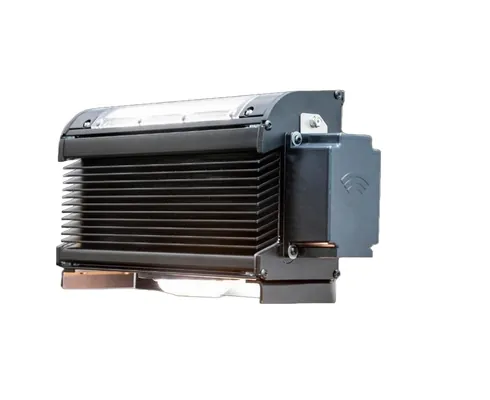
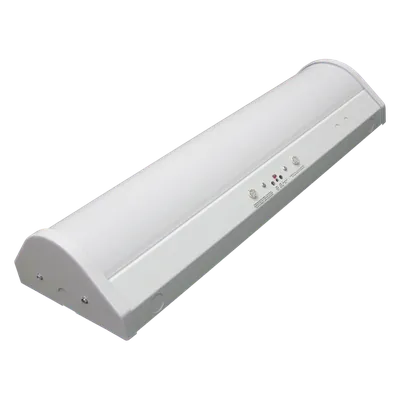
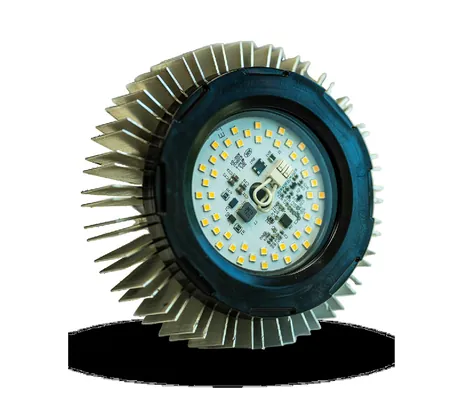
clearNET. We set it up once. After that, it runs itself.
A 900 MHz self-healing wireless mesh carried on the fixture itself. Every MTLx is a node and a repeater; the gateway sits at the station platform, so there is no cabling in the bore. Light levels, Work Mode, NFPA 130 self-tests and fault reports run on schedule and arrive in your inbox. In NYCT revenue service since 2018.
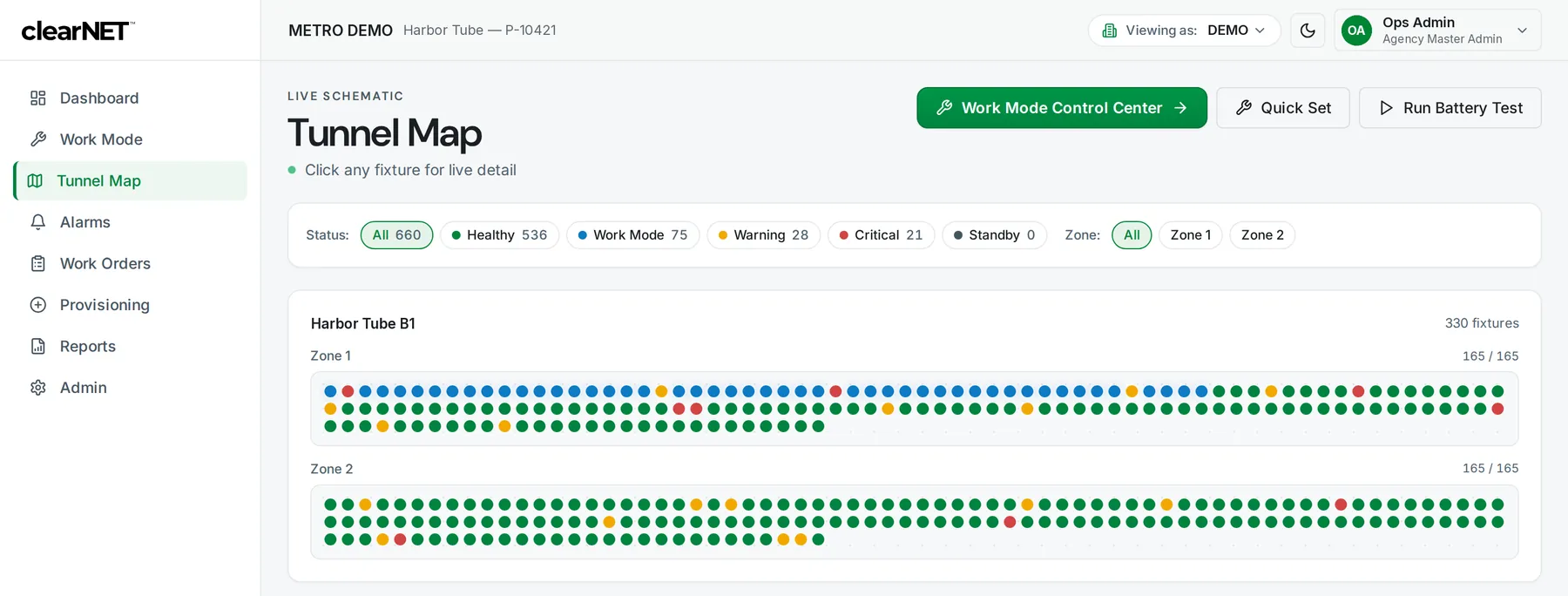
One gateway at the platform. Every fixture is the network.
clearNET is a 900 MHz self-healing wireless mesh built for one environment: the inside of a tunnel. Not a building protocol asked to survive underground — a radio designed for concrete, steel, curvature and moving trains, carried on the fixture itself. In NYCT revenue service since 2018 and tuned to NYCT specification 16ES.
We commission it
Clear-Vu provisions every fixture, verifies node-to-node margin and hands over a mesh that is already reporting. No agency IT project.
It heals itself
Nodes discover their own neighbours and re-route around a failed or removed fixture. Adding fixtures extends the mesh; nothing is re-planned.
You get autopilot
Light levels, Work Mode windows, NFPA 130 self-tests and fault reporting run on schedule. The agency is notified, not asked to go looking.
Reports come to your inbox.
Two surfaces, and an agency only needs one of them. The dashboard is there when someone wants to look; everything that matters arrives on its own. Scheduled reports export daily, weekly or monthly, with a master-admin audit log of every control action.

Work Mode comes off a magnet.
A crew touches a magnet wand to the underside of any fixture from the walkway. clearNET propagates Work Mode across the entire tunnel segment for eight hours, then reverts every fixture to NFPA 130 egress on its own. No app, no login, no dispatcher, no site visit to turn it back off.
Read-only and control endpoints for SCADA, BMS and EAM platforms, so lighting state and fault data land in the systems an agency already watches.
Frequency separation from CBTC
900 MHz operation sits outside the 2.4 GHz band used by most U.S. CBTC deployments. Across five-plus years and 3,000+ monitored fixtures, no CBTC interference incident attributable to the system has been identified by the host agencies.
Encrypted, segmented
AES-encrypted mesh traffic with OT/IT segmentation at the gateway — a defense-in-depth posture mapped to TSA SD 1582-21-01, IEC 62443 and NIST SP 800-82r3.
A floor no command can cross
The command dictionary contains no wireless instruction whose minimum legal argument falls below the NFPA 130 egress floor. Out-of-range commands are rejected at the firmware parser and logged. The worst attainable wireless attack is brighter light.
Linear-topology engineering
Tunnels behave as lossy waveguides with 21–32 dB train shadowing. Sub-GHz propagation and 1:1 fixture-to-node density keep margin through curves, crossovers and passing trains.
What the mesh is, in the language of a spec.
Values below are drawn from the 2026 MTLx family brochure and the Wireless Mesh Networks in Subway Tunnel Environments whitepaper. Project-specific radio surveys, node counts and gateway placement are confirmed by Clear-Vu engineering during commissioning.
| Band | 900 MHz licence-free (902–928 MHz ISM, FCC Part 15.247) |
|---|---|
| Separation from signalling | Sub-GHz — outside the 2.4 GHz band used by most U.S. CBTC deployments |
| Topology | Self-healing linear “string-of-pearls” mesh; every fixture is a node and a repeater |
| Node density | 1:1 fixture-to-node |
| Node-to-node reach | Up to ~3,000 ft demonstrated in straight bore; typical fixture spacing 15–30 ft |
| Gateway | One gateway at the station platform, outside the bore — no in-tunnel control cabling |
| Backhaul | Agency network at the gateway; cellular backhaul supported (Amtrak Hudson River Line) |
| Healing | Nodes discover neighbours and re-route around a failed or removed fixture; adding fixtures extends the mesh |
| Node location | Integrated in the MTLx end-can; sealed quick-connect to the housing |
| Availability | Standard on MTLx Pro (TL4064P) · option CN1 on MTLx OG (TL4064) · not offered on MTLx Mini |
| Light control | Per-fixture, per-zone or per-tunnel light level; presets from the 6 W NFPA 130 baseline through 1 fc and 2 fc settings |
|---|---|
| Work Mode | Magnet-wand trigger from the walkway; propagates across the segment; eight-hour timed cycle, auto-revert to egress |
| Monitoring | Fixture, driver, battery and thermal status; optional ambient temperature sensor (HS1) |
| NFPA 130 | Scheduled battery self-tests and emergency-lighting status reporting |
| Reporting | Scheduled exports daily, weekly or monthly; master-admin audit log of every control action |
| Dashboard | Tunnel map with live fixture-by-fixture states: healthy, Work Mode, warning, critical |
| Integration | Read-only and control endpoints for SCADA, BMS and EAM platforms; API / BACnet |
| Security | AES-encrypted mesh traffic; OT/IT segmentation at the gateway; posture mapped to TSA SD 1582-21-01, IEC 62443 and NIST SP 800-82r3 |
| Egress floor | No wireless command can set output below the NFPA 130 egress floor; out-of-range commands are rejected at the firmware parser and logged |
| Specification & origin | NYCT spec 16ES · BABA / BAA compliant · Made in Central Islip, NY |
Fixture power figures published for MTLx (6 / 10 / 16 / 60 W) include the clearNET node. Commissioning: Clear-Vu provisions every fixture, verifies node-to-node margin and hands over a mesh that is already reporting — no agency IT project.
Where clearNET runs underground
In revenue service with MTA New York City Transit and Amtrak, and field-tested on the London Underground.

~700 MTLx fixtures · 700 mesh nodes · 2021

~1,100 MTLx · clearNET on cellular backhaul

Transport for London · clearNET field test — no active installation
Where this product lives
A sample of installations specifying this product family. Reach out for the full project reference list.

The brochure, the whitepaper and the fixture it rides on.
The whitepaper benchmarks nine wireless protocols for tunnel use and documents the 900 MHz field results. Design and configuration guides are issued per project by Clear-Vu engineering.