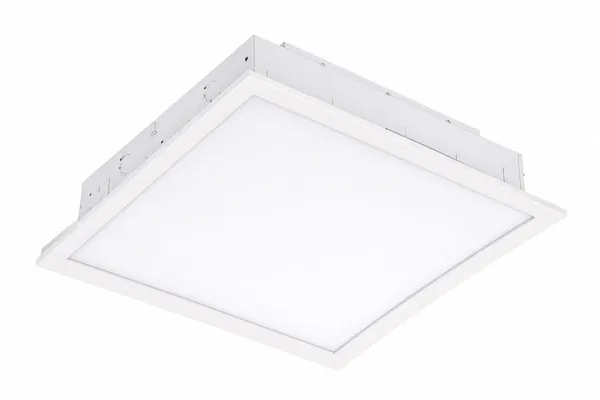
cleanLED Cleanroom LED Fixtures
ISO 14644-1 Class 3 through Class 8 rated fixtures engineered for pharmaceutical, biotech, and life sciences environments.

Engineered for Contamination Control. Uncompromised Light Quality.
The cleanLED platform is purpose-built for controlled environments where airborne particle counts, outgassing, and surface contamination directly impact product integrity and regulatory compliance. Deployed in pharmaceutical manufacturing, biotech research, and semiconductor fabrication facilities nationwide.
- ISO 14644-1 Class 3 through Class 8 rated for the widest cleanroom coverage
- IP66-rated sealed housing — highest particle and moisture protection short of submersible
- Non-outgassing materials — zero volatile organic compound emissions
- Edge-lit LED optics eliminate direct glare; smooth progressive surface for easy wash-down
- NSF certified and compliant with FDA manufacturing environment requirements
Semiconductor fab, advanced pharmaceutical compounding
Aseptic fill, sterile manufacturing, biotech production
Packaging, controlled corridors, gowning rooms
Key Specifications
| Cleanroom Classification | ISO 14644-1 Class 3 through Class 8 |
|---|---|
| Ingress Protection | IP66 (ISO 60598) — highest non-submersible rating |
| Hazardous Locations | Class I Division 2 & Class II Division 2 (optional) |
| Optical System | Edge-lit LED with light guide plate & diffuser — no direct LED glare |
| Correlated Color Temperature | 3,500K / 4,000K / 5,000K — Amber UV filtering & Yellow 101 available |
| Color Rendering Index (CRI) | 80 standard, up to 90 available — for accurate color identification in inspection, microscopy, and aseptic visual tasks |
| Lumen Output Range | 5,400 – 15,400 lumens (S1/M1/H1/VH1 light engines) |
| Lens | Clear tempered glass or clear impact acrylic, NSF silicone sealed |
| Lens Frame | Type 304 or Type 316 stainless steel, die-formed corners (no welds) |
| Housing Material | Extruded aluminum with die-cast aluminum end caps — 300% better thermal conductivity than 18-ga CRS; supports 1,000 lb walkable loading |
| Gasket | One-piece injection-molded closed-cell silicone — no vulcanized corners |
| Outgassing | Zero VOC emissions — all materials tested per ASTM E595 |
| Rated Lifespan | L80 > 50,000 hours |
| Dimming | 0-10V standard |
| Battery Backup | Optional 1,100 lm / 90-minute integral pack (standard or Class I Div 2 hazardous-location rated) |
| Mounting | Patented swing-out arm — universal install in 2.0" T-bar grid, 2"-3" walkable panels, and stick-built gypsum without removing the lens frame |
| Form Factors | CLF14 (1x4) · CLF22 (2x2) · CLF24 (2x4) |
| Voltage | 100-277VAC universal, > 0.90 power factor |
| Certifications | ETL Listed · NSF2 Splash Zone · DLC Qualified · LM79 / LM80 · MIL-STD 461F (optional) |
| Regulatory Compliance | FDA 21 CFR Part 211 environments, cGMP facilities |
Features & Benefits
Edge-Lit LED Optics
LEDs are hidden from view at normal angles. A light guide plate captures and channels light through a diffuser, producing wide uniform distributions with low direct glare — critical for inspection, microscopy, and aseptic visual tasks.
IP66 Sealed Aluminum Housing
A one-piece injection-molded closed-cell silicone gasket seals the housing flange to the ceiling and lens frame — no vulcanized corners to fail. IP66 is the highest ingress-protection level before submersible categories.
Non-Outgassing Materials
All materials tested per ASTM E595 for zero volatile organic compound emissions. No off-gassing that could contaminate sensitive pharmaceutical or semiconductor processes.
Particle-Count Compliant
Validated to ISO 14644-1 Class 3 through Class 8 particle count standards. Fixture design contributes zero additional particles to the controlled airspace during operation.
Stainless Steel & Aluminum Construction
Extruded aluminum housing (300% better thermal conductivity than 18-ga steel) with a Type 304 or 316 stainless steel lens frame. Die-formed corners avoid welding so chromium content stays intact — impervious to peroxide vapor, IPA, and bleach wash-down.
NSF2 Splash Zone & FDA Compliance
NSF2 Splash Zone listed for materials, cleanability, corrosion resistance and toxicity. Meets FDA 21 CFR Part 211 cGMP manufacturing requirements. DLC Qualified for utility rebate eligibility.
Hazardous-Location & MIL-STD Options
Optional Class I Division 2 / Class II Division 2 ratings for combustible-dust and flammable-vapor zones. Optional MIL-STD 461F (Air Force/Navy Fixed) testing for radiated/conducted emissions — safe near imaging, MRI, and sensitive lab equipment.
Built Different Than Conventional Cleanroom Fixtures
cleanLED was designed from the ground up for controlled environments — not adapted from a commercial troffer. Three engineering decisions set it apart from competing fixtures.
Die-Formed Stainless Lens Frame — No Surface Welds
The Type 304/316 stainless steel lens frame corners are die-formed and trimmed in a single piece — not notched and seam-welded like competing fixtures. Welding burns out the chromium content of stainless steel and creates rust-prone heat-affected zones.
Uniform Edge-Lit Illumination — No Light Bars Behind Glass
An edge-lit light guide plate channels LED output through an etched pattern into a diffuser, producing a perfectly uniform luminous surface. Competing cleanroom fixtures put visible LED strip bars behind a sheet of glass — you see hot stripes, dark gaps, and direct glare.
Extruded Aluminum Body — Heat Sink and Walkable
The housing is a heavy-gauge extruded aluminum profile (>.20″ wall thickness, finned) that doubles as a structural heat sink. Aluminum conducts heat 300% better than 18-ga steel, and the finned profile adds 70% more surface area — pulling heat directly off the LED junction.
Applications
The cleanLED platform serves controlled environments across pharmaceutical, biotech, semiconductor, and life sciences industries.
Where this product lives
A sample of installations specifying this product family. Reach out for the full project reference list.


Cleanroom Specification Deep-Dive
Detailed technical context for engineers, pharmacists, biosafety officers, and facility managers specifying lighting for controlled environments.
ISO 14644-1 Class 3 – Class 8: What Changes at Each Level
ISO 14644-1 defines cleanroom classes by the maximum allowable concentration of airborne particles per cubic meter. Each class step roughly represents a ten-fold reduction in allowable particle counts. Fixture selection, surface finish, and cleaning protocol requirements tighten as ISO class number decreases.
| ISO Class | ≥0.5 μm particles/m³ (max) | Typical Applications | cleanLED Configuration | Required IP | Cleanability Class |
|---|---|---|---|---|---|
| ISO 3 | 35 | Advanced semiconductor fab (EUV lithography), radiopharmaceutical compounding | CLF14/CLF22/CLF24 — IP66, stainless frame, glass lens, gaseous decon-compatible surface | IP66 | Wiped-down with validated protocol; IPA & VHP compatible |
| ISO 4 | 352 | Hard-disk drive manufacturing, precision optics coating | CLF14/CLF22/CLF24 — IP66, stainless frame, glass lens | IP66 | IPA & quat-amine compatible |
| ISO 5 | 3,520 | Aseptic fill & finish, sterile drug manufacturing, BSL-3 labs, HEPA-protected biosafety cabinets | CLF14/CLF22/CLF24 — IP66, stainless frame; MIL-STD 461F available on request | IP66 | Full washdown; hypochlorite & peroxide tolerant |
| ISO 6 | 35,200 | Pharmaceutical bulk API, medical device assembly, hospital compounding | CLF14/CLF22/CLF24 — IP65 or IP66 | IP65 min. | IPA, quat-amine, dilute bleach compatible |
| ISO 7 | 352,000 | Packaging zones, HVAC/anteroom buffer, sterile device packaging | CLF14/CLF22/CLF24 — standard configuration; NSF P442 variant for food-adjacent use | IP65 min. | Routine washdown; most common sanitizers |
| ISO 8 | 3,520,000 | Gowning rooms, controlled corridors, non-sterile fill, food-grade packaging | CLF14/CLF22/CLF24 — standard configuration; NSF P442 variant available | IP65 min. | Splash-zone washdown; NSF Splash Zone listed |
Particle counts per ISO 14644-1:2015, Table 1. Configuration requirements are application-dependent — confirm with cleanroom validation engineer and Clear-Vu specification team before ordering.
BSL-3 and BSL-4 Biocontainment Laboratory Compatibility
Biosafety Level 3 (BSL-3) and BSL-4 laboratories operate under CDC/NIH guidelines that impose strict requirements on interior surfaces, including lighting fixtures. The critical concerns are: no harborage points for biological agents, compatibility with gaseous decontamination agents, and sealed housing that prevents infiltration of contaminated air into the fixture cavity.
cleanLED is designed for BSL-3-compatible installations. Key engineering attributes that support BSL-3 use include the IP66-rated sealed housing (no open cavities communicating with the controlled space), one-piece closed-cell silicone gasket (no vulcanized corners that can crack and open pathways), and stainless steel or anodized aluminum exterior surfaces that resist the concentrations of vaporized hydrogen peroxide (VHP), chlorine dioxide (ClO₂), and formaldehyde vapor used in validated room decontamination cycles.
Gaseous decon compatibility: Aluminum housing with anodized or passivated stainless surfaces tolerates repeated VHP cycles (typical concentrations: 100–1,500 ppm, 30–60 minute exposure). Polycarbonate or glass lens options are both compatible with standard VHP protocols — confirm lens and gasket material selection with your decon protocol owner prior to ordering. The silicone one-piece gasket is inherently resistant to VHP, chlorine dioxide, and formaldehyde at the concentrations used for room decontamination.
NSF P442: The Food-Zone Hygiene Standard
NSF P442 is the NSF International protocol that governs lighting fixtures for food-contact and food-adjacent zones — the areas where food product, pharmaceutical ingredients, or sterile devices are directly exposed. It goes beyond IP-rating by requiring: no flaking or migratable coatings, no harborage-forming joints, drainable geometry, resistance to food-grade and pharmaceutical sanitizers, and foreign-object containment if a component breaks.
cleanLED was the first lighting fixture ever certified to NSF P442. That certification reflects design choices made before the standard existed: extruded aluminum housing with no painted exterior, a lens geometry that drains in a single direction, and captive fastener retention that prevents loose hardware from reaching product. When NSF formalized P442, cleanLED already met every requirement without re-engineering.
NSF P442-listed cleanLED configurations are also accepted for ISO 7 and ISO 8 pharmaceutical environments where contamination-prevention documentation is required by internal SOPs or regulatory agencies. See NSF P442 Explained for the full standard breakdown.
Hazardous Location Classifications
Certain pharmaceutical, biotech, and food manufacturing environments contain flammable vapors or combustible dusts that require luminaires rated for hazardous locations under NEC Article 500–506. cleanLED supports optional Class I Division 2 and Class II Division 2 ratings for installations in those zones.
| Classification | Typical Environment | cleanLED Support |
|---|---|---|
| Class I Division 2 | Flammable liquid or gas present in abnormal conditions (pharmaceutical solvent areas, alcohol-based sanitizer storage, spray-booth adjacency) | Available on request — specify at time of order. Includes compatible hazardous-location battery backup option (1,100 lm / 90 min). |
| Class II Division 2 | Combustible dust present in abnormal conditions (grain, sugar, starch, pharmaceutical powder handling areas) | Available on request — specify at time of order. |
LM-79 and LM-80 Photometric Test Data
LM-79 (IESNA LM-79-08) is a fixture-level photometric testing standard. It measures total luminous flux, luminous efficacy, chromaticity, color rendering index, and electrical characteristics of the complete luminaire as shipped. LM-79 reports are used by engineers to verify that a fixture performs as specified and by utilities to validate DLC qualification claims.
LM-80 (IESNA LM-80-08 / IES TM-21) is a component-level LED package lumen-maintenance standard. It characterizes how the LED chip's output degrades over time under controlled temperature conditions, allowing projection of L70 and L80 lifetimes. The cleanLED's rated L80 > 50,000 hours is derived from LM-80 data for the LED packages used and extrapolated per IES TM-21.
DLC qualification status varies by configuration. Always verify the specific DLC product ID at designlights.org before committing to a utility rebate calculation.
MIL-STD 461F Electromagnetic Compatibility
MIL-STD 461F is a U.S. Department of Defense standard that defines limits for radiated and conducted electromagnetic emissions and susceptibility of equipment. In the context of commercial and life-sciences facilities, it is relevant wherever sensitive electronic instrumentation — MRI scanners, mass spectrometers, electron microscopes, analytical HPLC systems, or defense-adjacent research equipment — must operate without interference from nearby power electronics.
LED drivers and control electronics in luminaires are a known source of conducted and radiated EMI at harmonic frequencies. Standard cleanLED configurations comply with FCC Part 15 Class A limits for commercial environments. For installations requiring compliance with MIL-STD 461F (RE102 radiated emissions, CE102 conducted emissions, typically Air Force/Navy fixed-site requirements), an MIL-STD 461F-tested driver and EMI-shielded driver compartment configuration is available on request.
Cleanability & Chemical Compatibility
cleanLED housing and lens materials are selected for compatibility with the cleaning and disinfection agents used in pharmaceutical, biotech, and food manufacturing environments. The following table summarizes compatibility at standard use concentrations. Always consult your cleaning validation team before introducing any new chemical or concentration into a classified cleanroom.
Compatibility guidance is based on material data at typical use concentrations. Project-specific chemical exposure scenarios may differ. Cleaning validation is the responsibility of the facility owner. Contact sales@clearvulighting.com for a material compatibility data package on any specific cleaning agent or protocol.
Corrosion Resistance, Leakage Prevention, and IP66 Sealed Lens Retention
The cleanLED housing is extruded aluminum with die-cast aluminum end caps — a material combination that provides approximately 300% better thermal conductivity than 18-gauge cold-rolled steel, actively drawing heat away from LED packages to extend lifespan. Aluminum alloys used are inherently corrosion-resistant in the pH range typical of pharmaceutical and food-processing wash-down environments (pH 5–9).
The stainless steel lens frame is available in Type 304 (standard) or Type 316 (marine-grade, recommended for environments with regular high-concentration chlorine or saline exposure). Type 316 offers superior resistance to chloride-induced pitting corrosion. Die-formed corners on the lens frame avoid welds — a critical detail because welding depletes the chromium-rich oxide layer that gives stainless steel its corrosion resistance.
IP66 sealed lens retention: The one-piece injection-molded closed-cell silicone gasket runs the full perimeter of the lens frame and housing flange, forming a continuous water-tight seal. Unlike gaskets assembled from four cut strips (which develop leak points at corners over time), the one-piece molded design maintains IP66 integrity across the entire seal perimeter throughout the fixture's service life. IP66 per IEC 60529 means complete protection against dust ingress and against powerful water jets from any direction — suitable for high-pressure cleanroom wash-down procedures.
Toxicity, Outgassing, and Material Suitability for Semiconductor and Biotech Cleanrooms
Volatile organic compound (VOC) emissions from luminaire materials are a contamination concern in ISO Class 3–5 semiconductor and biotech cleanrooms, where trace-level molecular contamination can affect wafer yield or biological assay results. cleanLED materials are selected and tested to minimize outgassing.
Key outgassing attributes:
- Housing: Anodized aluminum — no organic paint or powder-coat on surfaces exposed to the cleanroom airstream. Anodizing is an electrochemical oxide conversion; it contains no VOC precursors.
- Lens frame: Type 304 or 316 stainless steel — no coatings. Passivated surface only.
- Gasket: Closed-cell silicone — extremely low outgassing profile. Silicone (polydimethylsiloxane) is among the most chemically inert gasket materials available and is classified as NSF 51 food-grade safe.
- Lens: Clear tempered glass (zero VOC) or clear impact-resistant acrylic (low outgassing; verify with Clear-Vu for semiconductor-specific applications requiring ASTM E595 <1.0% TML / <0.1% CVCM compliance).
- Internal components: Driver, LED board, and wiring materials tested per ASTM E595 for total mass loss (TML) and collected volatile condensable materials (CVCM).
cleanLED Technical FAQ
-
What ISO Class cleanroom does cleanLED support?
cleanLED is designed for ISO 14644-1 Class 3 through Class 8 cleanrooms. ISO Class 3 is among the strictest controlled environments in commercial use (35 particles per cubic meter at ≥0.5 μm), while ISO Class 8 covers gowning rooms and controlled corridors. The fixture’s IP66 sealed housing, non-outgassing material set, and one-piece silicone gasket satisfy the contamination-control requirements across the entire ISO 3–8 range. Configuration — lens material, frame alloy, CCT, and optional ratings — should be matched to the specific ISO class during design. Contact sales@clearvulighting.com or call 516-941-3737 for a class-specific specification package.
-
Is cleanLED suitable for BSL-3 or BSL-4 laboratories?
cleanLED is rated for BSL-3-compatible installations. Its IP66 sealed housing has no open cavities communicating with the controlled space, the one-piece silicone gasket prevents infiltration, and the aluminum/stainless steel exterior surfaces are validated for vaporized hydrogen peroxide (VHP), chlorine dioxide, and formaldehyde decontamination protocols used in CDC/NIH Biosafety Level 3 laboratories. BSL-4 applications require project-specific engineering review due to the additional constraints those facilities impose on utility penetrations and room envelope integrity. Contact sales@clearvulighting.com to initiate a BSL-4 qualification package.
-
What cleaning agents can be used on cleanLED housings?
cleanLED housings are compatible with the agents most commonly used in pharmaceutical, biotech, and food manufacturing: 70% isopropyl alcohol (IPA), quaternary ammonium compounds (quats), sodium hypochlorite up to 1,000 ppm, hydrogen peroxide (liquid and VHP), peracetic acid at pharma/food concentrations, phenolic disinfectants, and glutaraldehyde/sporicidin products. Chlorine dioxide and formaldehyde are compatible on a conditional basis — specify Type 316 stainless steel lens frame for environments with repetitive high-concentration ClO₂ exposure, and confirm gasket lot documentation for formaldehyde decon cycles. A full material compatibility data package is available on request via sales@clearvulighting.com.
-
Does cleanLED support hazardous-location classifications?
Yes — Class I Division 2 (flammable vapor, abnormal conditions) and Class II Division 2 (combustible dust, abnormal conditions) ratings are available as optional configurations on request. Standard cleanLED units are not rated for Class I Div 1 or Class II Div 1. The hazardous-location battery backup option (1,100 lm / 90-minute integral pack) is also available in a Class I Div 2 configuration for emergency egress in solvent-handling zones. Specify hazardous-location requirements at time of order. Call toll-free 888-665-2627 or email sales@clearvulighting.com to discuss your NEC Article 500 classification.